Influences
Literary & Spiritual Influences in
Elizabeth (Franklin) Brigham Rooney's Life
Paternal Ancestry & Early Pioneers
Elizabeth & George Ripley, great grandparents
Elizabeth Franklin Ripley Brigham (1793-1879) was from a prominent New England Family. Her brother, George Ripley was a well known literary editor and critic at the New York Tribune, (from 1847 until his death in 1880), cofounder of the Brook Farm Association, along with Louisa May Alcott and Nathaniel Hawthorne, and the coeditor of The New American Cyclopedia, and Cyclopedia of Literature and the Fine Arts.
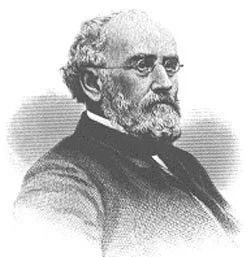
George Ripley Brigham, great uncle
His biographer wrote, "from one end of the country to the other the tributes to his enlightened capacity, to his distinguished knowledge, to his eminent skill as a discerner of thoughts, came in. Editors, writers of every class, critics of diverse schools, confessed his power, and celebrated the service he rendered to American literature. There was no dissenting voice."
The online Britannica Encyclopedia states, "as a literary critic Ripley was commonly judged the ablest critic of his day. He wrote one of the few popular reviews of Charles Darwin's On the Origin of Species. His popular success lay in his ability to reflect the values, aspirations and tasted of the educated Americans of the age."
Elizabeth Franklin Ripley Brigham's obituary describes her as a woman of much intelligence and culture; "one of those sterling characters who make grand pioneers. Coming to this city (Madison, WI, from Fitchburg, MA in 1839) when the nucleus of the place was just forming, she was been among the foremost who have worked for the intellectual and moral advancement of her fellow citizens. She was one of the original members of the Congregational Church and was a consistent, earnest Christian whose works bore the impress of her faith....she was a woman who never flagged in her care for others, she kept herself thoroughly informed upon all the leading events and questions of the day. She would conduct an intelligent discussion upon almost any topic."
"Mrs. Brigham has always seemed to me one of the finest types of New England womanhood...its quick intelligence, its deep conscientiousness, its large-minded devotion to the welfare of mankind and the Kingdom of God, its beautiful commingling of energetic self reliance with a hearty trust in God, were remarkably exemplified in her. Through her mother she was a close relative of Benjamin Franklin. Her father, Jerome Ripley, a merchant of trusted integrity, was a man of unusual balance and force of character, and was smitten with death while standing and conducting family prayers. Not only his distinguished son, the brother of Mrs. Brigham, who survives her, have made the name of Ripley eminent in theology and literature. The gifts of piety, intellectual force and sound judgment, which Mrs. Brigham had to so marked a degree, seemed, therefore to come to her by direct heredity."
Her husband and Elizabeth's paternal Great Grandfather, David Brigham (1786-1843) graduated from Harvard in 1810 (the family has passed down his Harvard Shakespeare collection, dated 1804), tutored at Bowdoin College and subsequently read law. At the time of his premature death in 1839, he was a senior member of the Madison bar, as well as and officer and founding member of the First Congregational Church. He also helped found the Madison Select Female School which met in the upstairs of his home on Butler Street. The school closed after one year due in part to financial difficulties, but reopened after his death, as the Madison Female Academy, in 1846, located on the corner of Wisconsin Avenue and East Johnson Street. This location is now famous as the location of the first classes held by the University of Wisconsin, Madison on February 5th, 1849; the leadership of the Female Academy agreed to let the fledgling University to occupy the ground floor of the building at no cost.
Jerome & Mary Brigham, grandparents
Jerome Ripley Brigham, David and Elizabeth's son, graduated from Amherst College in 1845. He taught school at the Madison Female Academy, and later served on the Board of Regents of the University of Wisconsin. He then followed in his father's footsteps and began practicing law in Madison, and later Milwaukee. He was appointed the first clerk of the supreme court, when Wisconsin entered statehood in 1848.
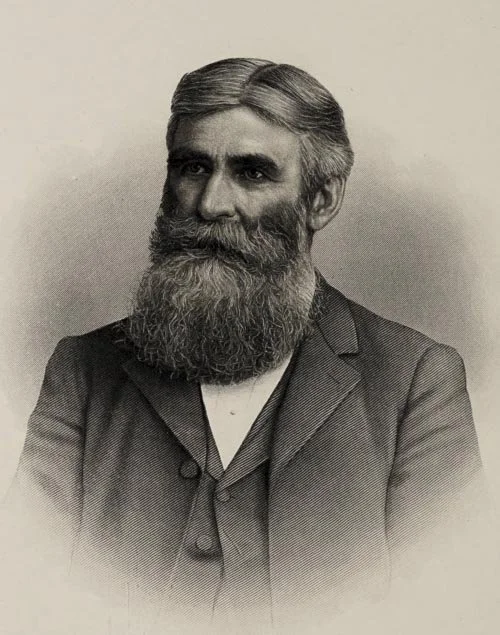
Jerome Ripley Brigham
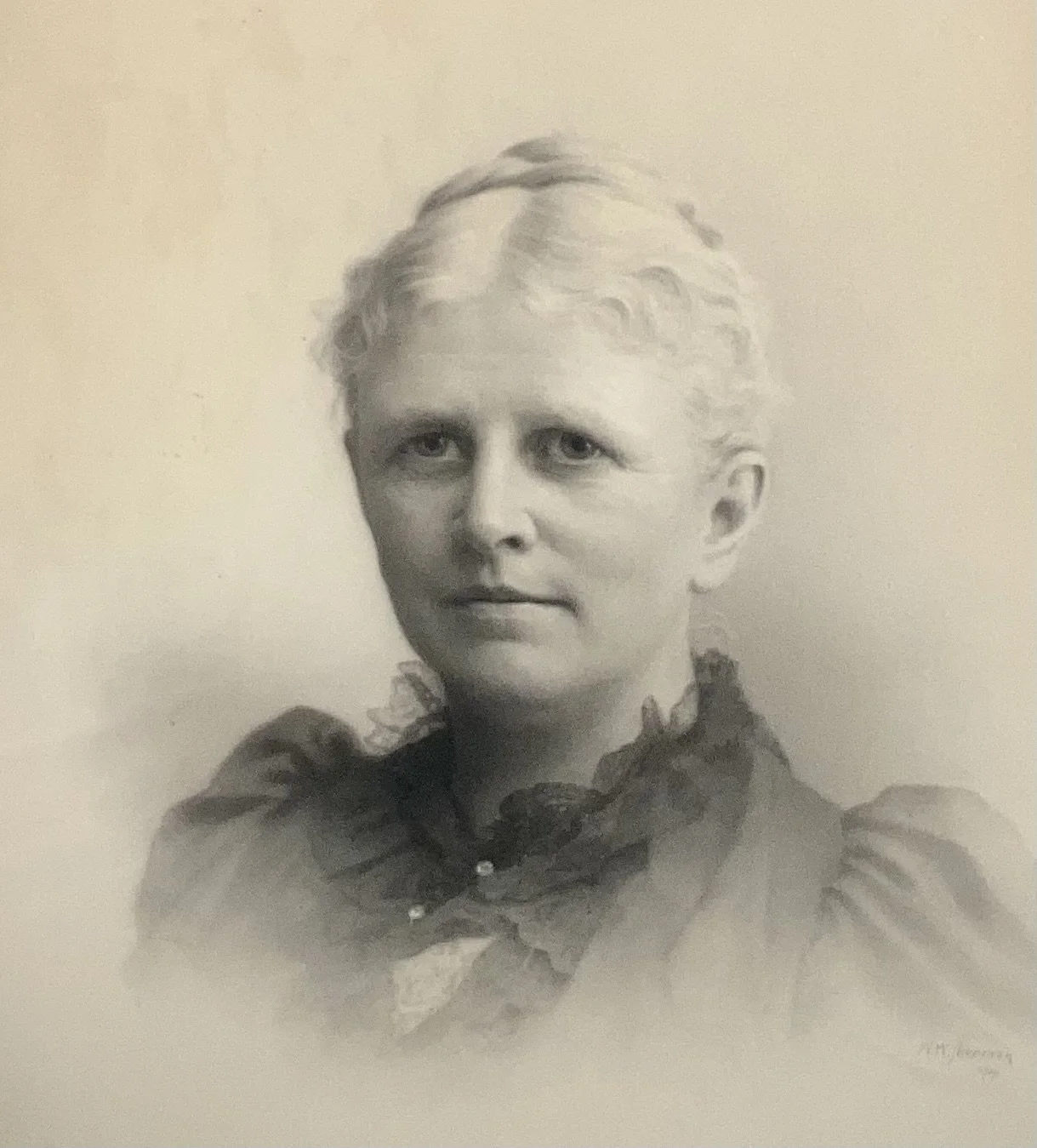
Mary Noyes Ilsley
While teaching at the Madison Female Academy, he met his future wife, Mary Noyes Ilsley. She was 13 years his junior, and they married when she was 19 years old; she apparently thought their courtship too lengthy for a man in his early thirties and let her feelings be known in this lighthearted, but sincere Valentine poem:
Dear Sir, do you know you're almost gray.
And grow more cautious every day!
Fearing you may be "taken in"
If a better half you try to win.
Now this delay, you'll rue at last
When once your day of grace is past
And you a bachelor doomed for life
No happy home, no smiling wife!
But if this counsel you will take
And seek some gentle loving wife
Then all dull care you may resign
And ever bless your Valentine.
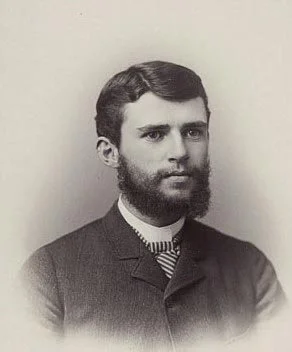
Charles Ilsley Brigham
It is no surprise then, that their son, Charles Ilsley Brigham (1862-1948), Elizabeth's father, inherited his parent's love of learning, along with a penchant for poetry.
Charles pursued a degree in Classical Literature at U.W. Madison, graduating in 1885. He taught for a while but after spending one winter on a ranch in Colorado decided to turn his hand and mind to farming on the family's property in Blue Mounds in 1888. Evidence of his love of literature has been passed down through many stories and even newspaper articles about the family's love of poetry in particular. Indeed, the way he proposed to his sweetheart, Rose Anna Gray, was to give her a framed photo of the panoramic view of his front porch with these lines from Christopher Marlowe's poem, A Passionate Shepherd to His Love, inscribed on the back: "If these delights thy mind may move...." Rose Anna knew the line that followed, "Then live with me, and be my love" and so could accept his proposal.
Parents and Childhood Literary Environment
Rose Anna Gray Brigham (1879-1959) was raised on a farm in Lamartine, Wisconsin, before becoming a teacher at a a Normal College. While we do not have as much information on her mother and father, we do have letters from her mother, Sarah Hood Gray, (1843-1915, b. Donegal, Ireland) writing to her daughter Frances about Rose Anna:
"Anna gave three dollars at the donation and wanted to give more but she isn't out of debt yet. She is a very good earnest christian girl."
And, "Mr. Ramsey told our minister that Anna was doing excellent work in her school."
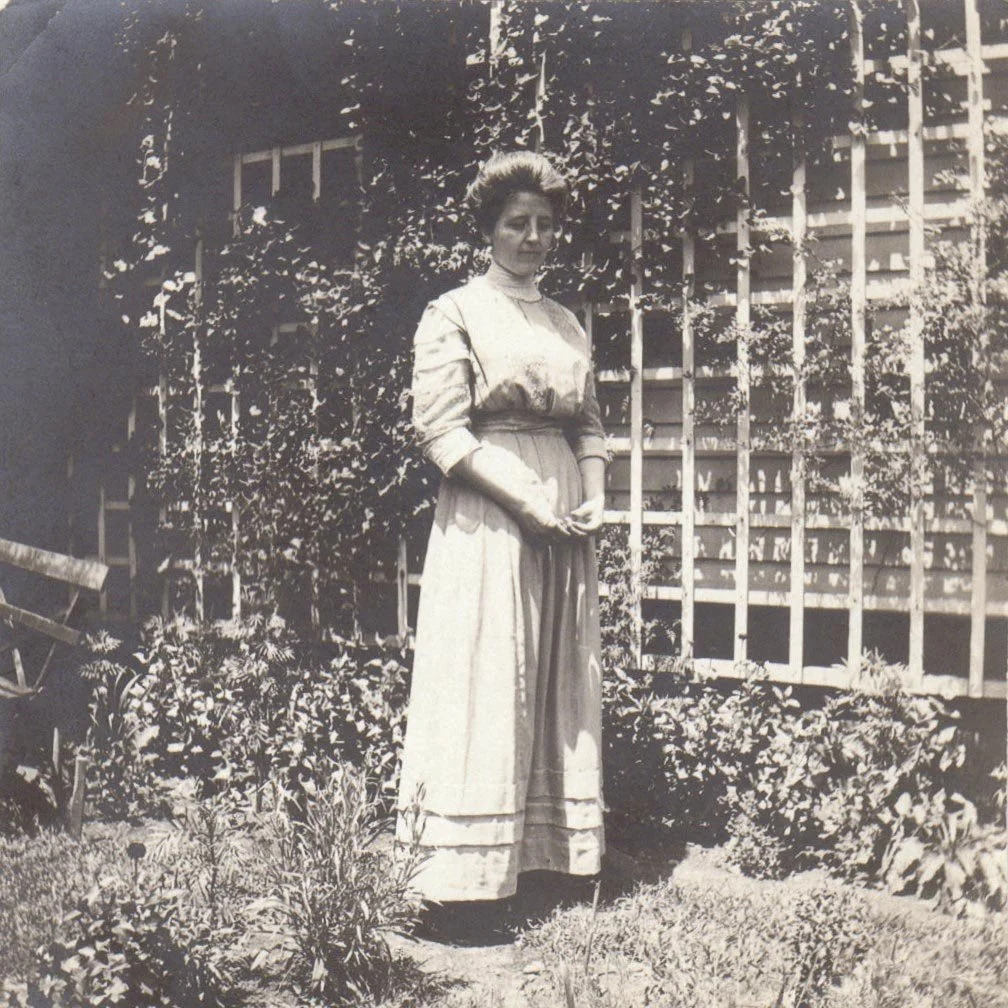
Rose Anna Gray Brigham, Elizabeth Rooney’s mother
Letter of recommendation for Rose from U.W. English Professor Arthur Beatty
After saving money earned as a school teacher she obtained a degree from the University of Wisconsin and went on to teach at a Normal College. A letter to the State Normal School in Moorhead, MN, from U.W. English Professor Arthur Beatty gave her a glowing recommendation.
She married Charles and moved to the farm in 1918. She kept a diary - just four lines a day in her tiny handwriting all her life - and the entries often included the book she was reading (ex. Sense and Sensibility on April 2nd, 1922) or the lectures she had attended, along with what she'd planted in the garden and the news of the day. We have her 12 page lecture notes entitled "Reading Material for the Child in the Home." It begins with an original poem (evidenced from the edits):
O for a book and a shady nook
Either indoor or out,
With the green leaves whispering overhead
Or the street cries all about,
Where I may read all at my ease
Both of the new and old
For a jolly good book whereon to look
Is better to me than gold.
She continues, "When our children feel that way about books then they have been led into the world both of enchantment and of reality. They have, then, in their hands the golden key that unlocks all the treasures of knowledge. In no other way can they learn the magic secrets of science - the triumphs and the defeats of kings and princes - the wonders of the earth and sky and the great mysteries of all the realms of the spirit."
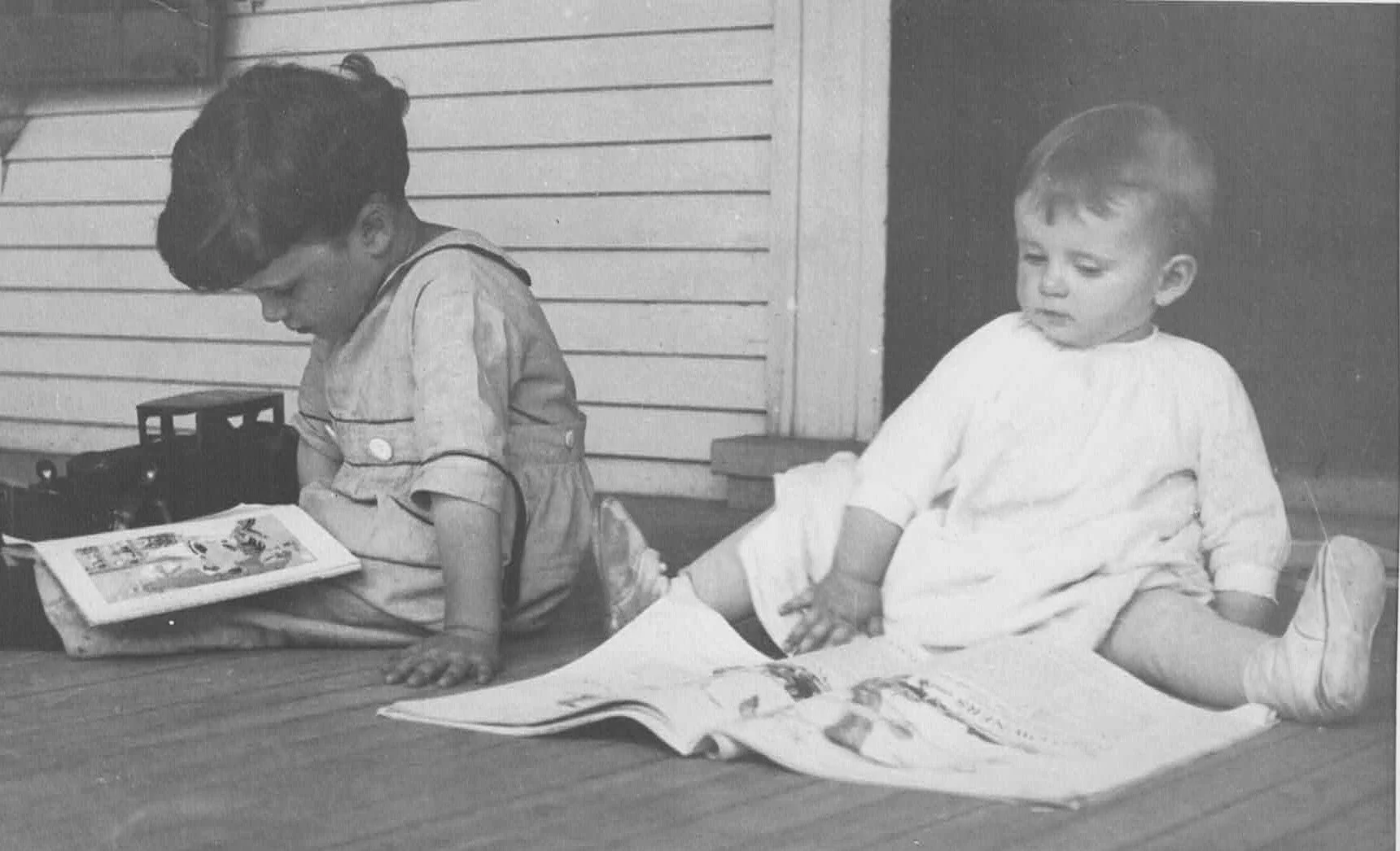
Charles Ilsley Brigham Junior and Elizabeth Franklin Brigham on the front porch of their home in Blue Mounds, WI
And so Elizabeth, and her brother, Charles Isley Brigham Jr., grew up surrounded by books and parents who read aloud, not only to the children, but to one another. Elizabeth recalled how they all teared up at the reading of the last line of Tale of Two Cities when the hero, Sydney Carton declares, "It is a far, far better thing that I do, than I have ever done."
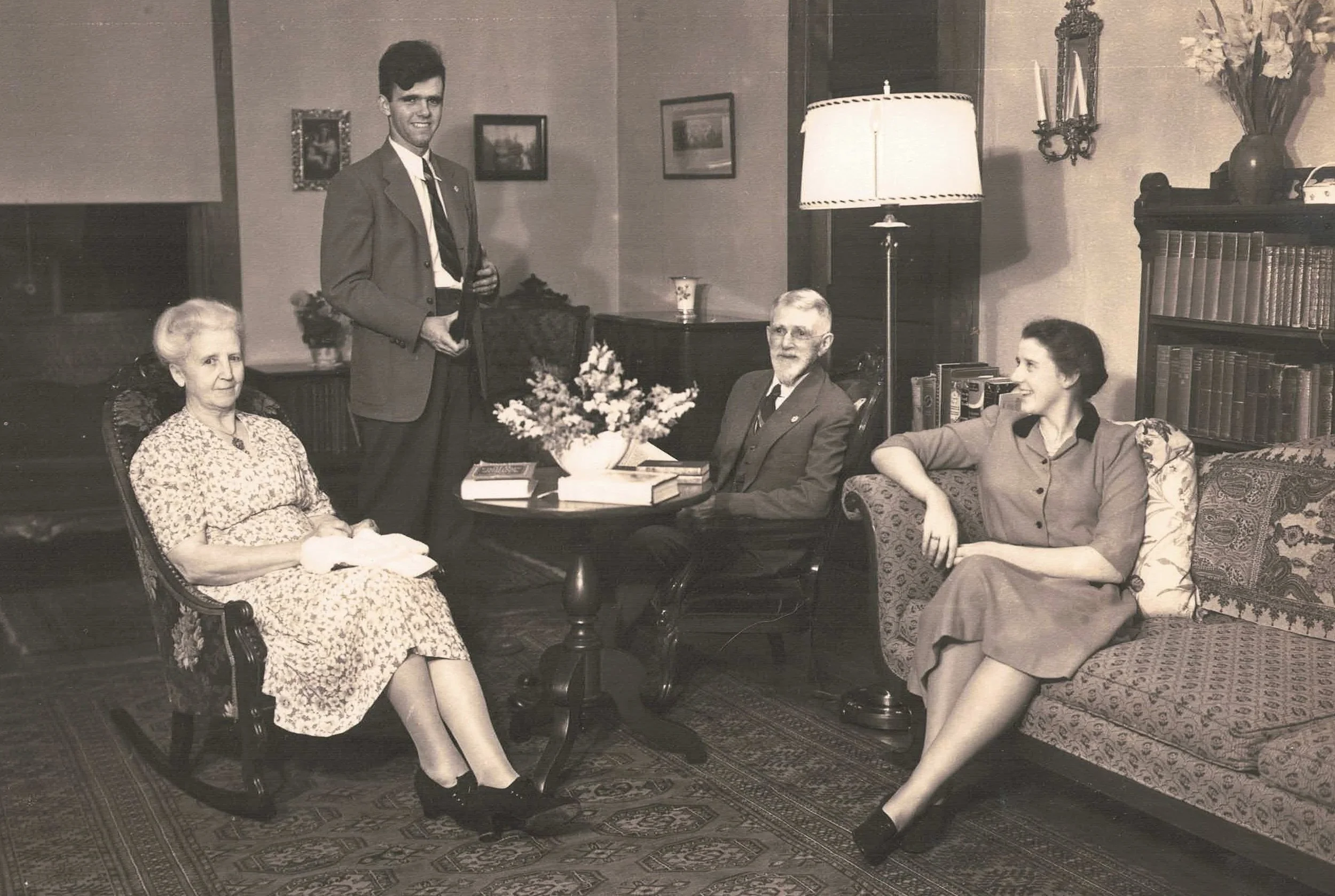
Brigham Family in their living room where they gathered to read, both alone and out loud to each other.
They grew up quoting lines of poetry at appropriate moments, such as the time when young Elizabeth said to her father, who was gently but forcefully trying to motivate her to do her work, "Unhand me graybeard loon!" (Rhyme of the Ancient Mariner...)
The family had a tradition of writing poems to accompany Christmas gifts; here we can read some of Elizabeth's first attempts at verse.
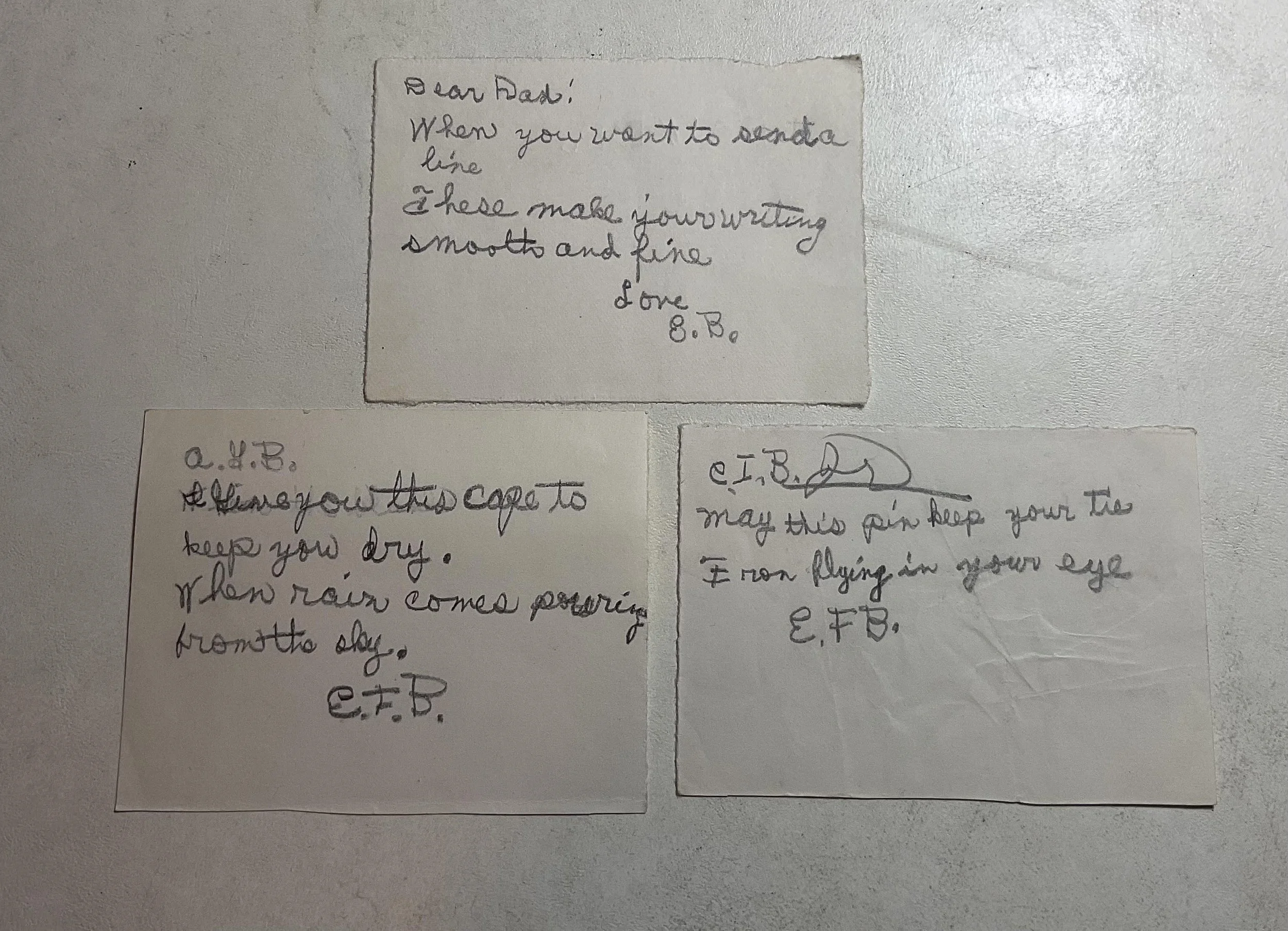
Here is a tongue-in-cheek verse written by a more mature Elizabeth accompanying to accompany her gift of the Brandenburg Concerto to a family member.
I am one of those people who would be willing to take a symphony to a pawn shop to hock
Because I cannot distinguish between the striking of a grandfather's clock and Bach.
And discerning a lullaby by Brahms fills me with qualms.
While the best handiwork of Sergei Rachmaninoff
Sounds to me like a vacuum cleaner being turned on an' off.
Neither can I tell a concerto from a sonata,
Although frequently told that I oughta.
Since, however, I know that music fills you with greater joy than that
which Jupiter derived from ambrosia and nectar
Or that which Andromache inspired in the bosom of Hector,
I am presenting you with the Brandenburg Concerto
Although I have never listened to it because I didn't care to.
Charles Brigham Sr. named his cows after Shakespearian heroines, as this line accompanying her gift to him of a book on Dairy Farming attests:
"You named your cows for Portia, for Beatrice and Juliet..."
Indeed, our grandfather had a particular love for the bard and started a Shakespeare Club which anyone in his rural community could join. They gathered to read the plays aloud, and the only rule was that you could not make fun of anyone's pronunciation.
Charles Brigham's dairy herd
Elizabeth helping on the farm as a young girl
Madison West High School senior
Education and Early Achievements
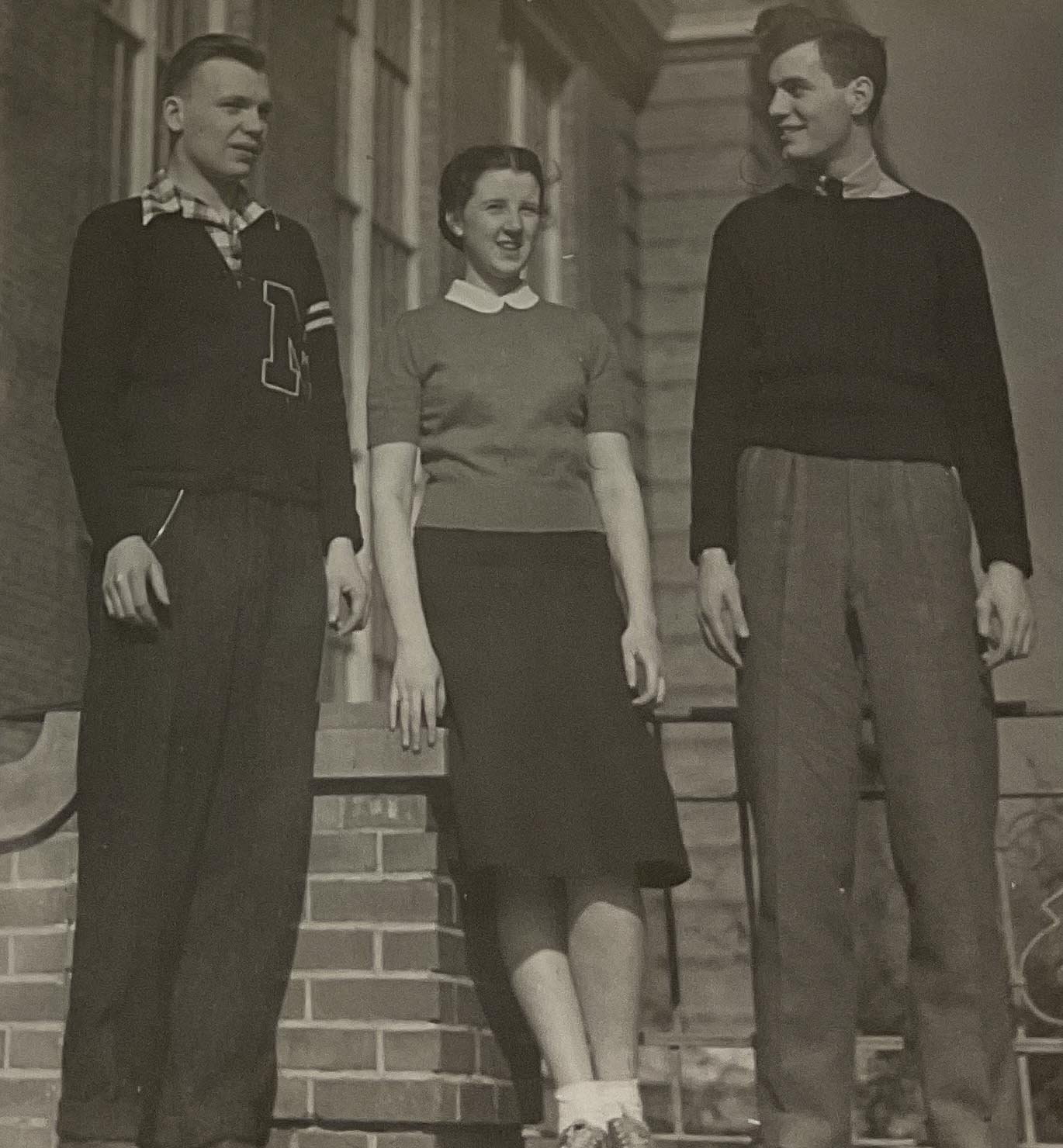
Elizabeth attended a one room school house in Blue Mounds until 8th grade, a lonely experience due to bullying by her peers. Her social life took a dramatic turn when she was allowed to live with relatives in Madison and attend West High School. She graduated in 1941, Phi Beta Kappa and salutatorian of her class. She was featured in the Wisconsin State Journal along with a reprint of her speech.
Elizabeth's quote at the beginning of the article, "To me, the freedom to create is most important of all varieties of freedom" reveals the desire she had at a young age to use her gift of writing, and specifically writing. The second to last stanza stands out as well, with a vision of freedom for all men, which was ahead of her time for a 1941 female graduate.
"And when at last upon the height we stand,
Stretching before us we shall see a land
Where men have banished hate, and black and white
In joyous fellowship work for the right,
Where friendship, cheer and peace of soul and mind
Reflect the gladness of a race grown kind."
Another article soon followed which summarizes both the literary and rural world in which Elizabeth was raised and nurtured.
Reprint of West High School salutatorian speech (WI State Journal)
Another story news story (paper unknown)